 By Tom Billy
Key Takeaways
UV spot curing systems deliver concentrated ultraviolet energy to defined areas, allowing compatible adhesives, coatings, and inks to cure quickly after receiving the required dose.
Faster curing can shorten production cycles, but actual cure time depends on the formulation, wavelength, irradiance, exposure duration, working distance, and geometry of the application.
UV LED systems may use less electricity and require less routine maintenance than certain lamp-based or thermal processes. Actual savings depend on the equipment and manufacturing process being compared.
In medical device assembly, repeatable light output and documented process settings can support manufacturing consistency. The completed process must still be validated for the specific product and its regulatory requirements.
UV curing does not automatically produce a stronger adhesive bond. Bond performance depends on correct material selection, surface preparation, joint design, adhesive application, and delivery of the appropriate UV dose.
Lamp-based and LED curing systems have different spectral outputs and operating characteristics. The light source must be matched with the absorption requirements of the photoinitiator in the material being cured.
Financial value should be evaluated through application testing and a complete cost analysis that includes equipment, integration, energy, consumables, maintenance, training, validation, and production requirements.
The Game-Changing Efficiency of UV Spot Curing in Manufacturing
How UV Technology Speeds Up Production Cycles
Manufacturing processes that rely on adhesives, coatings, or inks often include time for the applied material to set or cure. UV-curable formulations can shorten that waiting period because polymerization begins when the material receives light within the appropriate wavelength range.
UV spot curing systems direct concentrated energy toward a small bond area. This makes them suitable for precision applications in which the manufacturer needs to cure a defined location without exposing the entire component to the same light intensity.
Some compatible materials can cure within seconds, but there is no universal cure time. The necessary exposure is determined by several factors:
- Adhesive or coating chemistry
- Photoinitiator absorption range
- UV wavelength
- Irradiance at the cure site
- Total delivered dose
- Working distance
- Light-guide or optical configuration
- Bond-line thickness
- Substrate transmission
- Shadowed areas within the assembly
A short exposure is valuable only if the material receives enough energy to reach the required cure state. Moving the product too quickly through the process can result in incomplete curing, weak adhesion, surface tack, or inconsistent performance.
Manufacturers should establish a documented cure window through testing. Once the acceptable wavelength, irradiance, dose, and exposure time have been identified, those parameters can be incorporated into work instructions and monitored during production.
Comparing Energy Use: UV Systems vs. Traditional Methods
Energy performance varies among UV LED systems, UV lamp systems, thermal ovens, and other curing technologies. No single percentage accurately describes the potential savings for every application.
UV LED sources generate light within a narrower spectral range and can generally be switched on and off without the warm-up and cool-down periods associated with many traditional lamps. LEDs also tend to have longer operating lives and do not require routine bulb replacement.
Lamp-based systems remain useful when an adhesive requires a broader spectral output. Excelitas’ OmniCure S2000 Elite is a lamp-based spot-curing system designed to control and maintain optical output. Its broad spectral output may suit materials that respond to multiple wavelength bands.
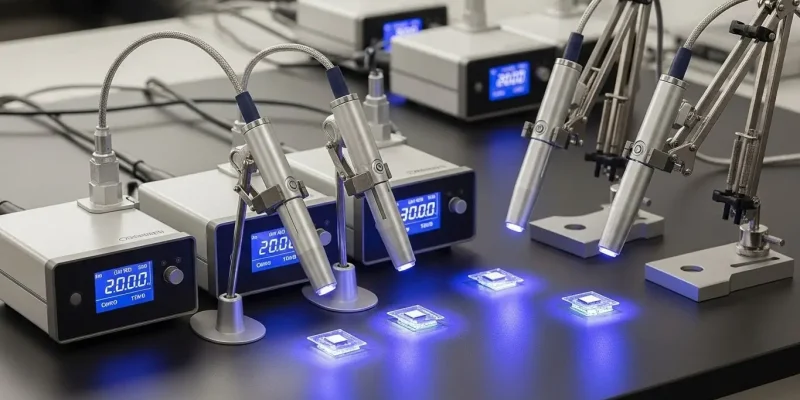
The OmniCure LX500 is an LED spot-curing platform available in two-channel and four-channel configurations. It uses independently controlled LED heads and monitors operating data to support optical stability.
Selecting between lamp and LED technology should begin with material compatibility and process requirements. Energy consumption, maintenance, warm-up time, cooling, output stability, wavelength availability, and equipment cost can then be compared using actual production conditions.
Raising Product Quality with Precision Curing Solutions
Why Consistency Matters in Medical Device Assembly
Medical device manufacturing often involves small bond areas, delicate components, narrow process tolerances, and detailed documentation requirements. UV spot curing may be used for products such as catheters, needles, syringes, sensors, tubing assemblies, and other components when the selected adhesive and device design permit light curing.
A UV curing system does not independently guarantee regulatory compliance or product quality. Manufacturers remain responsible for establishing and validating a process that consistently produces assemblies meeting their approved requirements.
Important process variables may include:
- Light-source wavelength
- Irradiance at the bond line
- Total UV dose
- Exposure time
- Distance between the light source and assembly
- Light-guide condition
- Adhesive quantity and placement
- Component alignment
- Environmental conditions
- Material storage and handling
Output can change because of lamp aging, LED temperature, contaminated optics, damaged light guides, changes in working distance, or incorrect equipment settings. Measuring irradiance at the cure site helps the manufacturer detect changes that might affect the process.
Excelitas offers radiometry and calibration equipment for its lamp-based and LED systems. These tools allow manufacturers to measure output, compare equipment, establish operating settings, and support a repeatable curing process.
The medical-device manufacturer must still complete the necessary risk analysis, verification, validation, equipment qualification, documentation, and change control for the specific application.
A Closer Look at Adhesive Bond Strength in Electronics
Electronics and optoelectronics may use UV-curable materials for component attachment, encapsulation, wire tacking, optical bonding, sensor assembly, display manufacturing, and protection of selected areas.
Fast curing can hold parts in position soon after alignment, which may be helpful when manufacturing small or sensitive assemblies. However, exposure to UV light does not automatically create a durable bond.
Final performance depends on:
- Compatibility between the adhesive and substrates
- Surface cleanliness and preparation
- Joint dimensions
- Adhesive thickness
- Material cure depth
- UV transmission through the substrate
- Wavelength and photoinitiator compatibility
- Delivered dose
- Thermal and mechanical operating conditions
- Moisture exposure
- Post-cure requirements
Some adhesives use a secondary curing mechanism for areas that the light cannot reach. Others may require exposure from more than one direction or a carefully selected light guide. Manufacturers should follow the adhesive supplier’s technical data and validate the complete assembly under anticipated operating conditions.
Thermal cycling, humidity, vibration, pull testing, shear testing, electrical testing, and optical testing may be appropriate, depending on the product. These evaluations demonstrate whether the complete bonding process satisfies the application’s requirements.
Cost-Effectiveness of Investing in UV Spot Curing Systems
Reducing Material Waste Through Accurate Application
UV spot curing can support an efficient adhesive process, but it does not determine how much adhesive is dispensed. Material use is controlled by the dispensing equipment, application method, component design, and operator or automated process.
A properly designed curing process may still help reduce waste by allowing the adhesive to be fixed quickly after placement. This can limit component movement and reduce the time during which uncured material can flow away from the intended bond area.
Potential sources of manufacturing waste include:
- Excessive adhesive dispensing
- Inaccurate component positioning
- Adhesive flowing into unintended areas
- Contamination of the bond surface
- Incomplete exposure
- Incorrect curing parameters
- Material stored beyond its approved conditions
- Changes in light-guide position or working distance
Manufacturers should evaluate dispensing and curing as connected processes. Controlled dispensing establishes the amount and location of the adhesive, while controlled UV exposure delivers the energy required to cure it.
Process trials can help determine the appropriate dispense volume, exposure conditions, fixture design, and sequence of operations. These settings should be documented after the acceptable process window has been established.
Long-Term Financial Benefits of UV Technology Adoption
The financial value of a UV spot curing system depends on the specific production environment. Faster cycle times may increase throughput, but the equipment must also be compatible with the material, assembly design, and required quality controls.
A cost analysis should consider:
- Purchase price
- Required LED heads, lamps, filters, or light guides
- Radiometry and calibration equipment
- Integration with automation or safety enclosures
- Operator and maintenance training
- Process-development and validation work
- Electrical consumption
- Cooling and ventilation requirements
- Consumable replacement
- Preventive maintenance
- Expected production volume
- Product changeover requirements
- Downtime and spare-parts planning
LED systems may reduce costs associated with lamp replacement and warm-up periods. Lamp systems may provide broader spectral output that is necessary for certain formulations. Selecting a less expensive system that does not match the adhesive can lead to incomplete curing, additional validation work, or equipment replacement.
No universal payback period applies. Manufacturers should test representative parts, estimate cycle-time improvements, calculate recurring operating costs, and compare the result with the current process before making an investment decision.
Versatile Applications: UV Spot Curing Across Industries
Spot Curing in Optoelectronics: What You Need to Know
Optoelectronic manufacturing often requires precise alignment and controlled bonding of small components. Potential applications include lenses, fiber-optic assemblies, sensors, cameras, displays, photonic components, and optical modules.
UV spot curing can help hold aligned components in place soon after the adhesive is exposed. The process must still account for the optical and mechanical requirements of the assembly.
The manufacturer should evaluate:
- Adhesive refractive index
- Optical clarity
- Shrinkage during cure
- Yellowing or discoloration
- Stress on aligned components
- Transmission of the substrate
- Thermal stability
- Moisture resistance
- Required wavelength and dose
- Long-term performance
Uniformity and repeatability are especially important when a small change in alignment could affect optical performance. Closed-loop output control and calibrated radiometry can help manage the light-delivery portion of the process.
Excelitas offers lamp and LED spot-curing technologies for electronics and optoelectronics. Product selection should be based on the material’s absorption characteristics, required spot size, production arrangement, working distance, and desired level of process control.
Adapting UV Systems for Diverse Manufacturing Needs
UV spot curing may be used in several industries, but the same equipment configuration will not suit every application. Manufacturers must match the system to the material, part geometry, cure area, process speed, and production environment.
Potential applications include:
- Medical device assembly
- Electronics manufacturing
- Optoelectronic assembly
- Automotive component bonding
- Sensor assembly
Different optical accessories can deliver light to the cure site in different ways. A single light guide may be appropriate for one bond point, while a multi-leg guide can expose several locations. Line adapters may be used for narrow rows, tubing, cables, or elongated components.
The OmniCure LX500 can operate multiple LED heads, which may support simultaneous or independently controlled curing locations. The OmniCure S2000 Elite provides lamp-based output with closed-loop feedback for applications requiring broad-spectrum light and controlled delivery.
Integration may involve fixtures, shielding, programmable logic controllers, robotic positioning, foot pedals, sensors, or other production equipment. The engineering team should confirm communication interfaces, timing requirements, equipment clearances, heat management, and safety controls before installation.
Application testing remains essential. A successful process must deliver the required dose to the intended location without damaging heat-sensitive materials, exposing personnel, or affecting surrounding components.
FAQ
What types of materials can UV spot curing systems be used with?
They can cure compatible UV-sensitive adhesives, coatings, and inks used with substrates such as glass, metals, plastics, ceramics, and composites. Suitability depends on the formulation and whether sufficient UV energy can reach the material. The substrate itself does not determine compatibility.
How does UV curing technology compare to other curing methods?
UV curing can provide shorter cycle times and localized exposure for compatible materials. Thermal, moisture, anaerobic, two-part, and other curing methods may be more suitable when light cannot reach the bond area or when the material requires another curing mechanism.
Can UV systems be integrated into existing production lines?
Many systems include controls and interfaces that support automated operation, but integration is not automatically simple. Manufacturers should evaluate physical space, shielding, fixtures, communication requirements, cycle timing, ventilation, working distance, and equipment safety.
What training is required for staff to operate UV curing systems?
Training should cover system controls, approved process settings, UV exposure hazards, personal protective equipment, shielding, emergency procedures, radiometer use, light-guide care, maintenance, and the handling requirements of the adhesive or coating.
How does UV curing contribute to sustainability efforts in manufacturing?
LED systems may reduce electricity consumption, warm-up time, and lamp-replacement waste in suitable applications. Faster curing may also improve throughput. Environmental benefits should be calculated from actual energy use, consumables, process waste, equipment life, and production requirements.
What are the safety considerations for using UV spot curing systems?
UV exposure can harm the eyes and skin. Appropriate shielding, interlocks, operating procedures, warning labels, and UV-rated protective equipment may be required. Ventilation needs depend on the curing material and light source. Operators should follow the equipment manual, safety data sheets, and workplace regulations.
What support and maintenance are available for UV curing systems?
Available support depends on the manufacturer, product, location, and service agreement. Maintenance may include cleaning optics, inspecting light guides, replacing lamps or filters, monitoring LED heads, measuring output, updating software, and calibrating radiometers at the recommended intervals.
What trends are shaping the future of UV curing technology?
Current developments include more stable LED output, additional wavelength options, improved thermal management, better radiometry, multi-head control, process-data collection, automation integration, and closed-loop monitoring. Lamp-based systems continue to serve applications that benefit from broad-spectrum output.
Useful Resources
- Excelitas OmniCure S2000 Elite UV Curing System
- Excelitas OmniCure LX500 UV LED Spot Curing Controller
- Excelitas OmniCure S1500 Pro UV Curing System
- Excelitas OmniCure R2000 UV Radiometer
- Excelitas OmniCure UV Curing Systems
- National Institute of Standards and Technology
- ASTM International
- Adhesive and Sealant Council
- IPC Electronics Standards
- Occupational Safety and Health Administration