 By Tom Billy
If you’ve encountered biltong before, chances are you already understand the mild obsession it tends to inspire. If you haven’t — or if your only exposure has been the vaguely similar but fundamentally different product sold in supermarkets — this guide is for you. Beef biltong is one of the great food traditions in the Southern Hemisphere: a curing and drying technique refined over centuries that produces something no other snack category quite replicates. Rich, complex, satisfying in a way that protein bars and commercial jerky simply aren’t. Australia has embraced biltong enthusiastically, and the quality of locally produced products has reached a level that rivals anything made in South Africa. Here’s what you need to know.
What Is Biltong and Where Does It Come From?
Biltong originated in Southern Africa, developed by Dutch settlers as a practical method of preserving meat during long overland journeys in the 17th and 18th centuries. The name itself comes from the Dutch words ‘bil’ (buttock, referring to the cut of meat) and ‘tong’ (strip or tongue). The curing process involved vinegar-soaking the meat, rubbing it with spices, and then hanging it to air-dry in the open atmosphere.
The technique was primarily a preservation necessity — refrigeration was obviously not available — but what was discovered, and what anyone who’s eaten genuinely good biltong knows, is that the process doesn’t just preserve meat. It transforms it. The acidic vinegar cure changes the protein structure. The spice rub adds flavour layers that develop during drying. The slow air-dry concentrates the natural beef flavour while creating a texture that varies from the moist, pink interior to a firmer, darker exterior.
Biltong is now produced and consumed globally, but it remains most culturally embedded in South Africa and countries with significant South African diaspora communities — Australia prominent among them. The South African population in Australia is substantial, and many of the best Australian biltong producers are first or second-generation South Africans bringing family recipes and generations of technique to a new continent.
Biltong vs. Beef Jerky: Understanding the Key Differences
The two products are often confused — both are dried beef, both are snack-format, both are shelf-stable. But the differences are meaningful and immediately apparent when you compare them side by side.
The Curing Process
Jerky is typically marinated and then cooked at elevated temperatures. Biltong is cured with vinegar and spices, then cold air-dried — no heat treatment is involved in the drying stage. This distinction fundamentally changes the flavour and texture outcome.
Spice Profile
Traditional biltong uses a specific spice profile — coriander seed (toasted and coarsely ground), black pepper, salt, and sometimes chilli and brown sugar. The coriander is the defining flavour note that distinguishes biltong from jerky. It’s warm, slightly citrusy, and becomes more pronounced as the drying process concentrates the flavours.
Texture
Biltong is sliced after drying, which means the texture varies based on how thick the slices are cut and how long the pieces have been dried. Wet biltong has a softer, more yielding texture with a pink interior. Dry biltong is firmer throughout. Most quality producers offer both, and the preference is genuinely personal.
Appearance
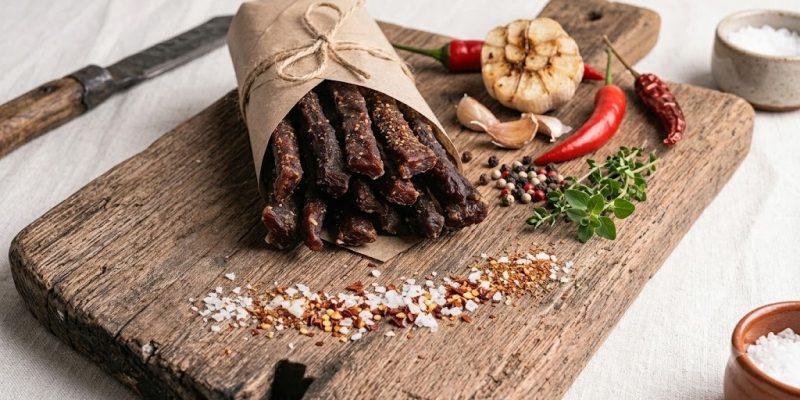
Where jerky is typically flat and uniform, biltong is thicker — the original pieces are hung and dried as full-cut portions before being sliced. The resulting appearance is more rustic, more visually substantial, and far more appetising than a thin strip of oven-dried jerky.
What Makes Quality Beef Biltong
The foundation of good beef biltong is the quality of the raw material. Lean, properly graded Australian beef — silverside or topside are the traditional cuts — provides the protein structure that the curing and drying process works with. Using MSA-graded Australian beef as the starting point means the tenderness and flavour consistency are built in before a single step of the production process begins.
From there, the vinegar cure matters. The best producers use quality brown malt vinegar — the traditional choice — at the right concentration and for the right duration. Under-curing produces a product that lacks the characteristic tang. Over-curing can make the outer surface overly acidified and the texture unpleasant. It’s a balance that experienced producers develop feel for over time.
The spice rub composition is where individual producers develop their signature. The coriander seed is non-negotiable for anything calling itself traditional biltong. Beyond that, the ratio of pepper, salt, and any additional spices reflects a recipe that may have been in a family for generations. The best biltong recipes are usually the ones that have been refined through decades of feedback rather than developed in a commercial lab.
Health Benefits of Biltong
Biltong has legitimate nutritional credentials that stand up to scrutiny. The combination of high protein content, minimal fat (in lean cuts), and the absence of artificial preservatives in quality products makes it one of the cleaner animal-protein snack options available.
- Protein: A 30-gram serve of quality biltong typically provides 16–22 grams of protein — comparable to a chicken breast on a per-gram basis.
- Carbohydrates: Traditional biltong recipes include minimal to no added sugar, so carbohydrate content is negligible. This makes it a useful option for low-carbohydrate dietary approaches.
- Iron: Beef is a significant source of haem iron — the most bioavailable form. For anyone with elevated iron requirements, including endurance athletes, this is a meaningful nutritional bonus.
- B vitamins: Beef is a rich source of B12, B6, and niacin. These nutrients survive the drying process and remain present in meaningful quantities in finished biltong.
- Zinc: Beef is among the richest dietary sources of zinc, which supports immune function and protein synthesis.
The caveat worth noting is sodium content. The curing process requires salt, and quality biltong does contain meaningful sodium. For most healthy adults this isn’t a concern in normal serving sizes, but those monitoring sodium intake should factor it in.
Types of Biltong Available in Australia
The Australian biltong market now spans a genuine range of styles and formats. Understanding the main categories helps you navigate your options:
Traditional Beef Biltong
Silverside or topside, traditional spice profile (coriander-dominant), available in wet or dry styles. This is the benchmark — if a producer can’t make great traditional biltong, they probably can’t make great anything else.
Fatty Biltong
Made from cuts with higher fat content — sometimes with the fat cap left deliberately on. The fat renders partially during drying and contributes a richness and moisture that lean biltong doesn’t have. This is a legitimate style with its own devoted following. Not for everyone, but for those who love it, the flavour depth is unmatched.
Chilli Biltong
Adds heat to the traditional profile. Quality varies enormously — the best chilli biltong has complex heat that builds gradually; the worst is just cayenne added at the last minute. Seek out producers who specify the chilli variety and heat level.
Specialty and Flavoured Variants
More adventurous producers now offer flavoured variants beyond the traditional profile — peri-peri, garlic-infused, smoked, and similar. These exist at the intersection of traditional technique and contemporary flavour interest. The best ones honour the process while expanding the flavour territory.
Buying Biltong in Australia: What to Look For
Given the diversity of quality now available online, a few practical principles help you avoid disappointment:
- Source transparency: Know where the beef comes from. Australian-made with Australian beef should be the baseline expectation.
- No artificial preservatives: Biltong doesn’t need them. If the ingredient list includes anything you wouldn’t find in a kitchen pantry, ask why.
- Pack date visibility: Fresh-packed is significantly better than sitting in a warehouse. Producers confident in their freshness will make this information available.
- Texture preference: Check whether the producer offers wet and dry styles, and be clear about your own preference before ordering.
- Reviews: Repeat purchasing is the clearest quality signal. Look for customer reviews mentioning they’ve ordered multiple times.
Serving and Pairing Suggestions
Biltong is most commonly eaten as a standalone snack, but it has genuine versatility beyond that. A few uses worth considering:
- Charcuterie boards: Thinly sliced biltong alongside quality cheese, olives, and chutney makes an excellent centrepiece for a grazing board.
- Biltong shavings on food: Very thinly sliced or broken biltong can be used as a flavour topping on salads, scrambled eggs, or avocado on toast. The concentrated umami flavour is remarkable.
- Beer pairing: Biltong and cold beer is one of South Africa’s great contributions to food culture. A malt-forward amber or a hoppy pale ale both work well.
- Lunchboxes and meal prep: A portion of biltong alongside cut vegetables provides a protein-forward, low-prep lunch component that travels well.
For Australians ready to explore the full range of what authentic biltong looks like, beef biltong made with MSA-graded Australian beef and traditional South African curing methods is where the category shows its full potential.
Conclusion
Biltong is not a trend. It’s a food tradition with centuries of history, refined technique, and genuine nutritional credentials. In Australia, the combination of expertise in authentic South African curing and a broader food culture increasingly hungry for quality, clean-label protein snacks has created the ideal conditions for biltong to finally reach the mainstream it deserves. Whether you’re a long-time biltong devotee or approaching it for the first time, the quality ceiling of what’s being produced in Australia right now is genuinely exciting. Start with a traditional variety, understand what good coriander-spiced beef tastes like when it’s done properly, and you’ll understand immediately why the people who love biltong tend to love it fiercely.