 By Tom Billy
Lighting is one of the largest controllable energy costs in most commercial buildings — and it’s also one of the most straightforward to address. The shift from fluorescent, metal halide, and high-pressure sodium lighting to modern LED technology has transformed the economics of commercial illumination. Where LED retrofits once carried a premium price tag that extended payback periods uncomfortably, today’s commercial LED products offer a combination of performance, longevity, and energy efficiency that makes them the obvious choice for almost any commercial property.
Yet many Perth businesses are still operating facilities lit by technology that’s 10, 15, or 20 years old — paying energy bills that could be substantially reduced while accepting inferior light quality and the ongoing maintenance burden of frequent lamp replacements. This article makes the case for commercial LED lighting installation, walks through the process, and covers the key considerations for Perth business owners and property managers evaluating an upgrade.
The Energy Economics of Commercial LED Lighting
The primary driver for most commercial LED upgrades is energy cost reduction. The numbers are compelling. Standard T8 fluorescent tubes — once the default for office and commercial lighting — consume 36 watts per tube. A direct replacement LED tube typically consumes 16–18 watts, representing a 50% reduction in lighting energy consumption with no change in light output. For a commercial facility with 100 fluorescent fittings running 10 hours per day, that’s a saving of approximately 180–200 kWh per day.
At Perth’s current commercial electricity rates, this translates to meaningful annual savings that, in most cases, cover the installation cost within 18–36 months. For larger facilities — warehouses, manufacturing plants, retail premises, car parks — the payback period is often shorter, particularly where high-intensity discharge (HID) lamps like metal halide are being replaced with LED high-bay fittings.
Beyond direct energy costs, consider:
- Reduced cooling costs — LEDs generate significantly less heat than their predecessors, reducing the load on air conditioning systems in climate-controlled environments.
- Dramatically lower maintenance costs — commercial LED products typically carry 50,000-hour rated lifespans, compared to 10,000–15,000 hours for quality fluorescent products. Fewer replacements means less labour cost and less disruption.
- HVAC interaction — in buildings with heat-sensitive products or processes, the reduced heat output of LED lighting has operational benefits beyond simple energy accounting.
What Does Commercial LED Lighting Installation Involve?
A professional commercial LED lighting installation can take several forms depending on the existing infrastructure and the scope of upgrade:
Lamp-Only Replacement
The simplest approach involves replacing existing lamps (tubes, globes, or reflector lamps) with compatible LED alternatives in existing fittings. This approach is cost-effective but limited — it retains older gear (the ballast, driver circuitry, and housing) that may reduce efficiency gains or create reliability issues. It’s appropriate for situations where the existing fittings are in good condition and the upgrade objective is primarily energy reduction rather than full performance optimisation.
Retrofit Kits
LED retrofit kits replace the internal components of existing luminaires — removing the fluorescent lamp, ballast, and starter, and replacing them with an LED driver and LED board. This approach maximises energy savings (bypassing the ballast eliminates its energy losses) while retaining the existing fitting housing. It’s commonly used in troffer fittings, recessed panels, and surface-mounted batten fittings.
Full Fitting Replacement
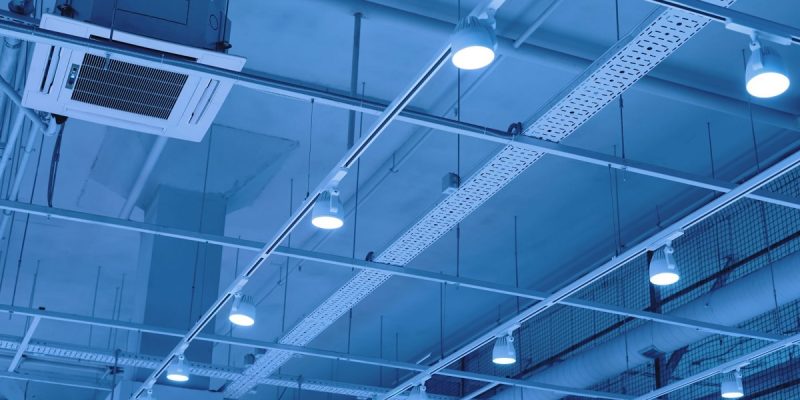
For older or high-maintenance fittings — high bay luminaires, exterior floodlights, car park canopy lights — full replacement with purpose-designed LED fittings typically delivers the best long-term outcome. Modern LED high-bay fittings offer adjustable optics, integrated sensors, and dimming capability that simply cannot be achieved by retrofitting older housings.
Lighting Design and the Importance of Getting Lux Levels Right
A common misconception in commercial LED upgrades is that LED simply replaces the previous lamp specification one-for-one. In practice, proper commercial lighting design involves calculating the maintained illuminance (lux) required for each space and selecting fittings accordingly.
Australian Standards (AS/NZS 1680 series) specify minimum average maintained illuminance levels for different commercial environments:
- Office general areas: 320 lux average maintained illuminance.
- Task lighting (detailed work): 500–750 lux.
- Warehouses and storage (general): 160–240 lux.
- Manufacturing (precision work): 500–1000 lux depending on task detail.
- Retail: 500–1000 lux for feature product lighting.
Specifying fittings without a lighting design calculation risks under-illuminating work areas (creating safety and productivity issues) or over-illuminating them (wasting energy and potentially causing glare). A qualified lighting contractor or commercial electrician with lighting design capability will produce a photometric plan before specifying fittings, ensuring compliance with Australian Standards and optimal visual comfort.
Smart Lighting Controls: Maximising the Value of Your LED Investment
LED lighting’s compatibility with smart controls is one of its most significant advantages over legacy technology. Integrating controls into a commercial LED lighting installation can further reduce energy consumption by 20–40% beyond the base LED savings:
- Occupancy sensors — automatically dim or extinguish lights in unoccupied spaces. Particularly effective in office areas, meeting rooms, amenities, and storage.
- Daylight harvesting — photocell sensors detect available natural light and dim artificial lighting proportionally. Effective in perimeter office zones, retail frontages, and any space with substantial window area.
- Time scheduling — programming light levels across business hours, after-hours security lighting, and off-hours operation through building management system (BMS) integration.
- DALI or 0–10V dimming — digital (DALI) or analogue dimming protocols allow individual fixture or zone-level control from a central system.
For new commercial installations or significant refits, investing in a DALI-addressed lighting control system provides maximum flexibility for both current operation and future reconfiguration.
Government Incentives and Energy Efficiency Schemes
Western Australian businesses undertaking commercial LED lighting upgrades may be eligible for financial incentives through energy efficiency schemes. It’s worth noting that Synergy (WA’s primary electricity retailer) has historically offered business energy efficiency programmes. Engaging an energy consultant or your commercial electrician to advise on current incentives before committing to a project specification can identify opportunities to reduce the net cost of the upgrade.
Choosing the Right Contractor for Your Commercial LED Upgrade
The quality of a commercial LED lighting installation depends on both the product specification and the quality of the installation work. Key factors when selecting a contractor:
- Photometric design capability — can the contractor produce or commission a proper lighting design with lux calculations, or are they simply swapping fittings based on wattage equivalence?
- Product quality — look for fittings with high-quality drivers, credible CRI (Colour Rendering Index) ratings of 80+ for occupied spaces, and warranties of at least 3 years (preferably 5).
- Licensed electrical work — all wiring work in the installation must be carried out by or under the supervision of a licensed WA electrician.
- Post-installation documentation — the contractor should be able to provide Certificates of Electrical Compliance and, for larger projects, an as-installed photometric report.
Conclusion: The Time to Upgrade Is Now
Commercial LED lighting technology has matured to the point where there is no compelling reason to continue operating legacy lighting systems in Perth’s commercial buildings. The combination of energy savings, reduced maintenance burden, improved light quality, and compatibility with smart controls creates a business case that’s difficult to argue against — particularly given the current cost of commercial electricity in WA.
A well-executed upgrade pays for itself, reduces your operating costs for years afterward, and delivers a better working environment in the process. The key is engaging a contractor who brings genuine lighting design knowledge to the project, not just a willingness to swap lamps.