 By Tom Billy
Ask around in almost any Perth family with a military history and you’ll find the same thing: a shoebox, a biscuit tin, or a zip-lock bag sitting in a wardrobe somewhere, holding a collection of medals, ribbons, photographs, and service documents. Kept safely for decades. Rarely looked at. Almost never displayed.
The intention to do something meaningful with these items is usually there. But the combination of not knowing where to start, uncertainty about how to do it properly, and a sense that the task requires getting it right — because the items are irreplaceable — means it keeps getting deferred.
War medal framing is the answer most families eventually find, and it transforms both how those items are stored and what they mean in the life of a household. A properly framed tribute to a veteran’s service isn’t just a display — it’s a form of acknowledgement that passes meaning from one generation to the next.
Why so many families haven’t done this yet
Before getting into the how, it’s worth acknowledging the why — because understanding the hesitation helps explain what a good framing experience should address.
The most common barrier is uncertainty about what’s appropriate. Military medals carry protocols, history, and significance that most civilian families don’t feel equipped to navigate. Which way do the medals face? What order should they go in? Is it respectful to display original service photographs next to medals? What if the ribbons are damaged — should they be replaced?
These are legitimate questions, and they’re the questions a good military memorabilia framer should be able to answer with authority. The framing studio is not just a place to get things mounted behind glass — it’s a source of guidance on presentation conventions, conservation requirements, and compositional decisions.
The second barrier is fear of damage. These items are irreplaceable. Handing them to a stranger and having them worked on feels like a significant risk. Understanding the conservation practices that a quality framer uses — and asking the right questions before leaving anything — addresses this directly.
Understanding what you have before you frame it
Before visiting a framer, it’s worth taking stock of what’s in the collection and what condition each item is in.
The medals themselves are typically the centrepiece of any display. Australian service medals are generally made from cupro-nickel or bronze alloy, and most are in better condition than families expect. Light tarnish is normal and is part of the medal’s history — aggressive cleaning is not advisable.
Ribbons vary significantly in condition. Ribbons from WWI and WWII service are over 70 years old and are often faded, brittle, or soiled. Replacement ribbons are widely available and are routinely used in court mount presentations.
Photographs are among the most valuable additions. Service photographs — formal portraits in uniform or candid images from deployment — add a human dimension that medals alone cannot provide.
Documents — discharge certificates, service records, commendations, identity discs — can be incorporated into the frame or stored separately. Original documents in fragile condition should be assessed by the framer before any decision is made.
The ordering of Australian service medals
Medal ordering is one of the questions families most often ask, and getting it right matters — particularly for displays that will be viewed by others who served.
Australian service medals are displayed left to right from the viewer’s perspective, in a specific order of precedence. The broad categories are:
- Imperial gallantry awards — the Victoria Cross and George Cross sit at the head of any collection.
- Australian gallantry awards — the Star of Gallantry, Medal for Gallantry, and related awards follow.
- Campaign and service medals — awarded for specific theatres of service, ordered by campaign date and date of institution.
- General service medals and clasps — recognising service in specific operations.
- Defence and long service awards — recognising length and dedication of service.
- Allied and foreign awards — displayed after all Australian awards.
A reputable war medal framing specialist in Perth will be familiar with the correct sequence and can advise on any specific ordering questions.
Court mount or swing mount: what’s the difference
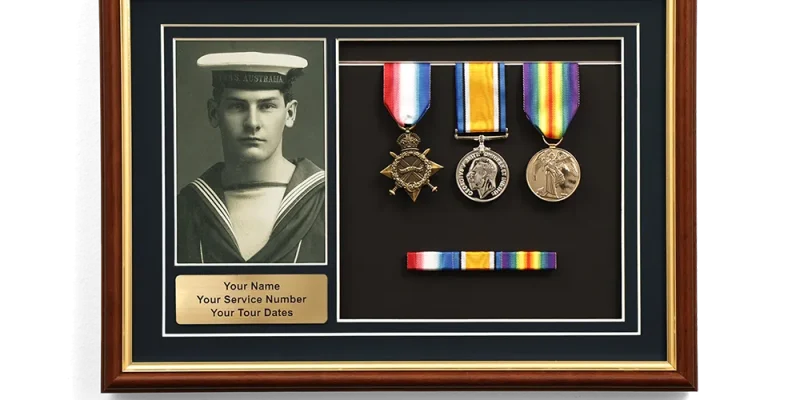
A court mount (also called a hard mount or parade mount) has the medals mounted firmly on a backing with the ribbons folded flat — identical to how medals are worn on a formal parade uniform. The result is a compact, precisely ordered presentation.
A swing mount allows the medals to hang freely from their full ribbons in a natural pendant position. This is a softer, more domestic presentation that shows the medals as they would be worn in a relaxed context.
Neither option is more or less respectful. The choice comes down to the family’s preference and the aesthetic of the space where the frame will hang.
Building the composition: what to include
A frame that tells the full story of a serviceperson’s career is more powerful than one displaying medals alone.
Photographs are usually placed in the composition to provide context for the medals. A formal portrait in uniform alongside the medals creates a direct visual connection between the person and the awards.
Rank insignia — shoulder titles, unit patches, rank chevrons, cap badges — add visual variety and contextualise the service branch and career progression.
Service documents — a discharge certificate, a commendation letter, an identity disc — can be featured as elements of the composition.
Engraved name and service dates — many families choose to include a small engraved plate bearing the serviceperson’s name, rank, service number, and dates of service. This is particularly valuable for future generations.
Conservation: protecting the collection inside the frame
Everything that goes inside a military memorabilia frame should be protected by conservation-quality materials.
UV-filtering glazing is essential. Perth’s UV intensity means that ribbons will fade noticeably in direct or indirect natural light without UV protection.
Acid-free backing and mounting boards prevent the chemical degradation that acidic materials cause over time.
No adhesive on original items — medals, photographs, documents, and insignia should be held using conservation methods that don’t involve adhesive touching the surface.
Appropriate depth for three-dimensional items — medals have physical depth, and the frame needs to accommodate them without the glazing pressing against the medal face.
Anzac Day timing and why to plan ahead
The weeks immediately before Anzac Day are the busiest period for military memorabilia framers. Families who have been intending to have a tribute framed for years often find that the approaching commemorative date finally prompts them to act — and they frequently find that quality framers have extended turnaround times as a result.
If Anzac Day is your intended completion date, planning two to three months ahead is sensible. Quality custom framing — particularly a carefully composed military memorabilia display — takes time to do well, and rushed work rarely produces the result these items deserve.
Conclusion
A well-framed tribute to a veteran’s service is one of the most meaningful things a family can do with their military history. It takes items that have been stored out of sight — kept safely but not truly honoured — and transforms them into a permanent, visible acknowledgement of the sacrifice and service they represent.
The process requires knowledge of material conservation, military protocol, and compositional craft that most families don’t have in-house. That’s exactly what a good specialist framer provides.
The medals were earned over a lifetime of service. Getting the framing right is the least a family can do in return.